Put Your Hands In It: Lebanese Cooking as a Radical Act of Slowing Down
Somewhere between the DoorDash notification and the fifth meal kit ad on your Instagram feed, a quiet rebellion is happening in a lot of American kitchens. People are rolling grape leaves by hand. They're kneading kibbeh until their palms are stained with allspice and pine nuts. They're tearing bread at the table instead of eating alone over a sink.
This is Lebanese cooking. And right now, it might be the most countercultural thing you can do on a weeknight.
The Industrial Food Complex Doesn't Want You to Slow Down
Let's call it what it is: the modern food industry has spent decades convincing us that cooking is a chore to be optimized. Meal prep culture—with its color-coded containers and Sunday batch routines—reframes the kitchen as a productivity problem to solve rather than a place to actually live. Meal kits promise "home cooking" while quietly removing every moment of genuine engagement with food. Even cooking apps now default to time-to-table as the primary metric of a good recipe.
None of that is inherently evil. Life is busy. People are tired. But something real gets lost when we stop treating cooking as an experience and start treating it purely as fuel delivery.
Lebanese food doesn't really fit that framework. And that's the point.
Kibbeh Doesn't Care About Your Schedule
Take kibbeh—the iconic Lebanese dish built on finely ground lamb mixed with bulgur wheat, onion, and warming spices. The traditional preparation involves hand-kneading the mixture until it becomes smooth, almost silky, with a texture that no food processor fully replicates. Lebanese grandmothers (and a lot of Lebanese grandmothers' grandchildren, to be fair) will tell you they can feel when the kibbeh is ready. Not measure it. Feel it.
That's not mysticism. That's embodied knowledge—the kind that lives in your hands after you've made something enough times that your body understands what your brain is still learning. You can't rush that. You can't app your way to it.
The same goes for hand-rolling grape leaves (warak enab). Each leaf gets laid flat, a small spoonful of rice and herb filling placed just so, then rolled with a specific tension—tight enough to hold together during cooking, loose enough to allow the rice to expand. It takes practice. Your first batch will probably look a little rough. By your fourth or fifth, your hands will know what to do without you telling them.
This is cooking as a physical skill, not a recipe to execute.
The Table Is the Point
Here's what meal prep culture fundamentally misunderstands about food: the meal isn't just about nutrition or even flavor. It's about the context in which you eat it.
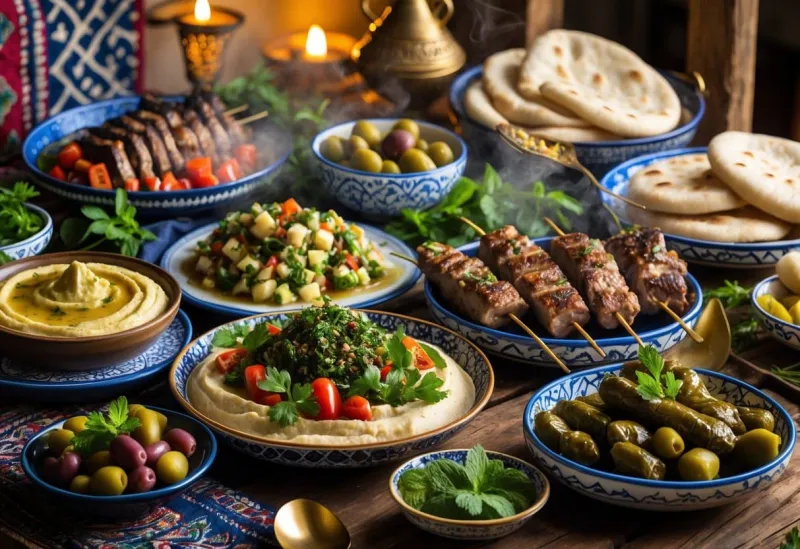
Lebanese food is almost structurally designed to be shared. Mezze—the spread of small dishes that forms the foundation of Lebanese entertaining—doesn't really work as a solo meal. You need people. You need someone to reach across the table for the hummus while someone else refills the pita. You need conversation that stretches out over two hours because no one is in a hurry to leave.
This isn't accidental. Lebanese culinary culture evolved in a context where hospitality is essentially a moral value. Feeding people well, feeding them abundantly, and making them feel genuinely welcome at your table isn't just nice—it's important. The food reflects that. Dishes are built to be passed, not plated individually. Bread is torn, not sliced. Dips are communal. Even the act of making Lebanese food together—multiple people in the kitchen stuffing pastries or folding fatayer—is part of the experience.
Compare that to heating a meal kit in separate components and eating it in front of a laptop. Both technically count as eating. Only one of them counts as a meal in any meaningful sense.
Mindfulness Without the App
There's a whole wellness industry built around the idea of mindfulness—being present, engaging your senses, slowing your thoughts. People pay good money for guided meditations and breathwork sessions to achieve what making a batch of Lebanese sweets can do for free.
Maamoul—the delicate semolina cookies filled with date paste or pistachio and pressed into carved wooden molds—requires your complete attention. The dough has to be the right texture. The filling has to be portioned just so. The mold has to be tapped firmly enough to release the cookie without breaking it. You cannot do this while scrolling your phone. You cannot do this on autopilot. The cookie will let you know.
The same meditative quality runs through making labneh (straining yogurt into thick, spreadable cheese over many hours), preparing a proper tabbouleh (hand-chopping parsley so fine it becomes almost fluffy), or slow-cooking a pot of Lebanese lentil soup until it reduces into something deeply warming and complex. These are processes that reward patience and attention in ways that a 20-minute meal simply can't.
You Don't Have to Choose Between Efficient and Meaningful
This isn't an argument for abandoning convenience entirely. Nobody is suggesting you stone-grind your own flour before making pita on a Tuesday. Lebanese home cooking, even in Lebanon, involves shortcuts and adaptations. Canned chickpeas are fine. Store-bought phyllo dough is perfectly acceptable. Your grandmother probably had a few tricks she didn't advertise.
But there's a difference between smart shortcuts and completely opting out of the cooking experience. Lebanese food invites you to stay in the kitchen a little longer, to involve other people in the making, and to sit at the table a little longer once the food arrives.
That's the real ask. Not perfection. Not hours of labor every night. Just presence.
Come Back to the Kitchen
If modern meal culture has made you feel like cooking is a task to minimize rather than an experience to have, Lebanese food is a gentle but firm invitation to reconsider. The recipes are generous. The techniques are learnable. The reward—a table full of people eating something you made with your own hands, tearing bread and talking too loudly and staying way too long—is genuinely hard to replicate by any other means.
Put your hands in it. The kibbeh is waiting.