Feed Your Brain, Feed Your Soul: The Real Neuroscience Behind Why Lebanese Food Makes You Happy

Photo by Photo by Queensland, Australia on Unsplash on Unsplash
You've probably experienced it before. You sit down to a spread of hummus, warm flatbread, slow-cooked lamb, and a dozen little dishes you can't stop reaching for — and somewhere between the second bite and the third cup of tea, something shifts. The tension in your shoulders drops. The conversation gets easier. You feel, for lack of a better word, good.
That's not a coincidence. And it's not just nostalgia, either. What you're feeling is your brain responding to a very specific combination of inputs — sensory, social, nutritional — that Lebanese food has been delivering, without any formal clinical trials, for centuries.
So what's actually happening up there? And more importantly, how can you recreate it on a Tuesday night in your American kitchen?
Your Brain on a Lebanese Dinner Table
Let's start with the basics. Dopamine and serotonin are the two neurotransmitters most closely associated with feelings of pleasure, reward, and emotional well-being. Dopamine fires when you anticipate or experience something rewarding — the sizzle of meat hitting a hot pan, the first whiff of garlic blooming in olive oil. Serotonin is more of a slow burn: it's tied to mood stability, a sense of calm, and that deep satisfaction that lingers after a really good meal.
Registered dietitian and food-mood researcher Dr. Maya Haddad (who grew up eating her teta's cooking in Dearborn, Michigan) puts it plainly: "Lebanese cuisine hits almost every known dietary and behavioral trigger for serotonin and dopamine production. It's not one thing — it's the whole system working together."
That system has a few key components.
The Spice Cabinet Is Doing Heavy Lifting
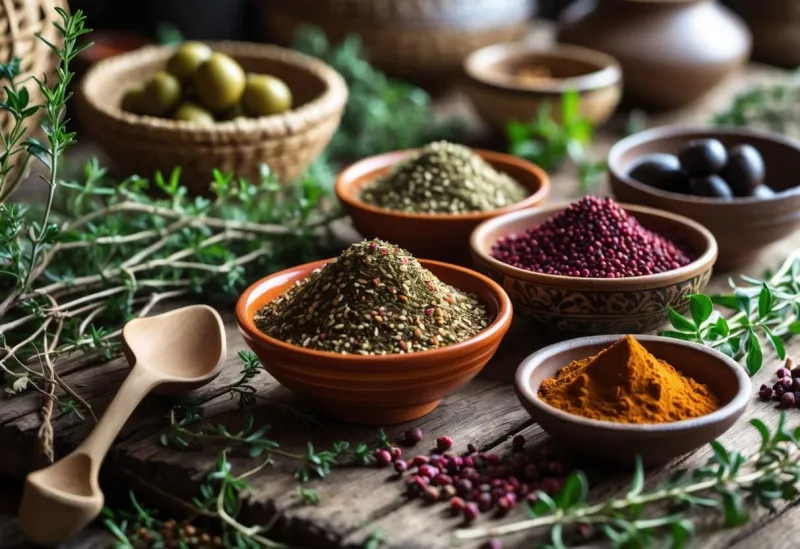
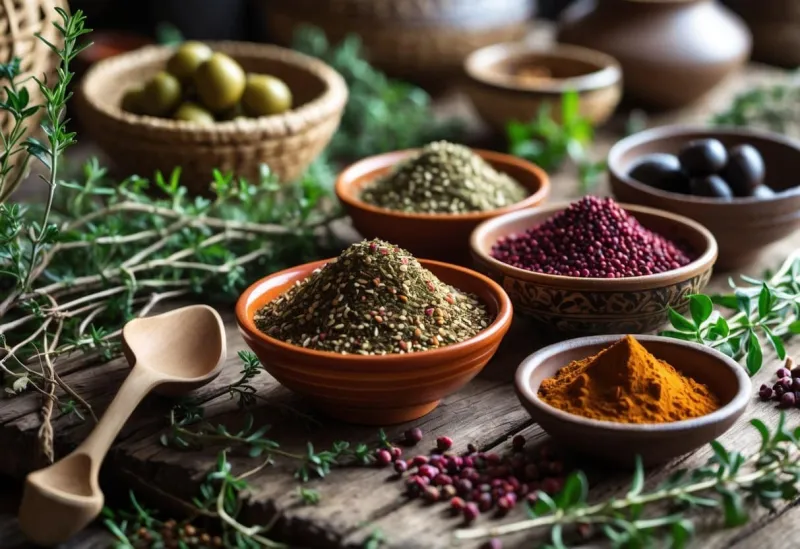
Za'atar, sumac, cinnamon, turmeric, allspice, cumin — the Lebanese spice rack reads like a functional neurology checklist.
Turmeric's active compound, curcumin, has been studied extensively for its role in increasing brain-derived neurotrophic factor (BDNF), which supports the growth of new neurons and is closely linked to mood regulation. Cinnamon has shown promise in stabilizing blood sugar, which prevents the mood crashes that come with glucose spikes. And saffron — used in some Lebanese rice and dessert preparations — has been compared in small studies to low-dose antidepressants for its effect on serotonin pathways.
Then there's the aromatic experience itself. Smell is the only sense with a direct line to the limbic system, the brain's emotional processing center. When you inhale the scent of toasted cumin or fresh mint, you're not just smelling dinner — you're triggering emotional memory and reward circuits simultaneously. For Lebanese-Americans, that smell often carries decades of family history with it. But even for someone encountering these aromas for the first time, the neurological response is real.
Fermented, Pickled, and Gut-Happy
Here's something that often gets overlooked in conversations about Lebanese food: the gut-brain connection.
About 90 percent of your body's serotonin is produced in the gut, not the brain. And the health of your gut microbiome directly influences how much of it gets made. Lebanese cuisine has always included fermented and probiotic-rich elements — leben (a tangy cultured dairy similar to yogurt), fermented turnip pickles (those gorgeous magenta ones you see at every Lebanese table), and labneh, which is strained yogurt with active cultures.
"These aren't trendy wellness additions," says Dr. Haddad. "They've been staples of Lebanese eating for generations, and they're doing exactly what modern gut-health research says they should — supporting a microbiome that produces mood-regulating neurotransmitters."
If you want to start somewhere, add a small bowl of labneh or pickled turnips to your next home meal. Your gut — and your mood — will notice.
Eating Together Is the Actual Secret Ingredient
No amount of turmeric or fermented dairy can fully replicate what happens neurologically when you eat communally. And Lebanese food is, at its core, a communal architecture.
The mezze format — where many dishes arrive together and everyone reaches, shares, and passes — is not just a serving style. It's a social bonding mechanism. Research from the University of Oxford found that eating with others is one of the single strongest predictors of life satisfaction, stronger even than income or relationship status. Shared meals increase oxytocin levels (the bonding hormone), reduce cortisol (the stress hormone), and extend the duration of positive social interaction.
Samir Khalil, a Lebanese-American food writer based in Los Angeles, describes it this way: "In my family, no one eats alone. Even a quick lunch becomes a gathering. The food is almost secondary to the act of sitting together — but the food is also what creates the sitting together. They're inseparable."
Designing a meal around sharing, rather than individual plating, is one of the simplest ways to activate these social-neurological rewards at home.
How to Engineer Joy Into Your Next Meal
You don't need to recreate a full Lebanese feast to access these benefits. Here are some practical ways to bring the neuroscience of Lebanese dining into your everyday cooking:
Lead with aromatics. Toast your spices before adding them to a dish. Bloom them in warm olive oil. Let the smell fill the kitchen before anyone sits down. That olfactory hit primes the reward system before the first bite.
Add something fermented. A side of labneh, a few pickled vegetables, or even a good quality yogurt alongside your meal supports gut serotonin production. Make it a regular part of the table, not an afterthought.
Go multi-dish, even on weeknights. You don't need twelve plates. Three or four small dishes served together — a dip, a salad, a warm protein, some bread — shifts the meal from individual consumption to shared experience. That shift matters neurologically.
Slow it down. Lebanese meals are rarely rushed. Longer eating duration allows satiety hormones to catch up with consumption, prevents overeating, and extends the window of social connection. Put the phones away. Refill the water glasses. Let it go long.
Use your hands sometimes. Tearing bread, scooping hummus, rolling grape leaves — tactile engagement with food activates sensory pathways that distracted or utensil-only eating doesn't. It sounds small, but embodied eating is genuinely different from mechanical eating.
The Joy Was Always Intentional
What's striking, when you look at Lebanese food culture through a neuroscientific lens, is how deliberate it all seems — even though none of it was designed in a lab. The communal format, the fermented sides, the spice complexity, the slow pace, the emphasis on hospitality: every element that makes Lebanese dining emotionally resonant also happens to be neurologically optimal.
Maybe that's not a coincidence either. Maybe generations of Lebanese cooks figured out, through lived experience and cultural wisdom, that food prepared with care and eaten together is the most efficient happiness technology humans have ever invented.
All you have to do is set the table.