Why Does Lebanese Food Make You Feel So Good? The Science of a Joyful Kitchen
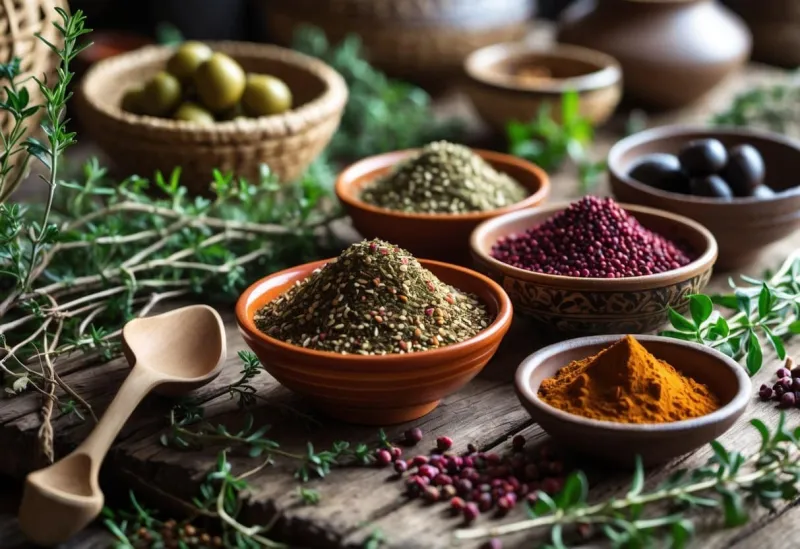
Photo: Lebanese kitchen herbs spices za'atar sumac colorful ingredients flatlay, via amazingfoodanddrink.com
You know that feeling. You walk into a kitchen where someone's been cooking Lebanese food — garlic hitting olive oil, dried herbs warming in a pan, pomegranate molasses drizzled over something bright and fresh — and something in your chest loosens. You exhale. You're suddenly, inexplicably, in a better mood.
That's not a coincidence. And it's not just nostalgia for Lebanese-American home cooks who grew up around sitto's stove. Scientists and food researchers are increasingly interested in exactly why certain cuisines produce measurable emotional responses — and Lebanese cooking keeps showing up in the conversation.
Your Brain on Sumac (and Za'atar, and Lemon)
Let's start with the aromatics, because that's usually where the joy begins.
The human olfactory system — the part of your brain that processes smell — is directly wired to the limbic system, which governs emotion and memory. Unlike taste, which takes a more roundabout neurological route, smell hits the emotional centers of your brain almost instantly. This is why a whiff of something familiar can flood you with feeling before you've even registered what you're smelling.
Lebanese cooking is, at its core, an aromatic cuisine. Za'atar — that earthy, slightly tangy blend of wild thyme, sumac, and sesame — contains thymol and carvacrol, compounds that have shown mild mood-lifting properties in preliminary research. Sumac itself is rich in antioxidants and delivers a tartness that activates the brain's novelty-response pathways. Simply put, it's interesting to your brain in a way that plain food isn't.
Cinnamon, allspice, and coriander — all staples in Lebanese spice blends — have been studied for their potential to reduce cortisol, the stress hormone. Whether you're cooking a pot of lentil soup or layering spices into a kibbeh filling, you're essentially aromatherapy-ing your kitchen without even trying.
The Ritual of Preparation as Its Own Reward
Here's something food psychologists have been emphasizing more in recent years: the act of cooking is itself a form of emotional regulation.
Mindfulness researchers have found that repetitive, tactile tasks — kneading dough, rolling grape leaves, forming kibbeh by hand — activate the parasympathetic nervous system, the one responsible for the "rest and digest" state. It's the opposite of fight-or-flight. Your heart rate slows. Your attention narrows to what's right in front of you.
Lebanese cooking is full of these kinds of tasks. Stuffing zucchini. Layering fattoush. Rolling out manakeesh dough. For many Lebanese-American home cooks, these aren't chores — they're the point.
"I don't cook Lebanese food because it's fast," says Nadine, a home cook in Dearborn, Michigan who learned to make kibbeh from her mother. "I cook it because when I'm standing there shaping those little footballs, I'm not thinking about anything else. It's the only time my brain actually shuts up."
This isn't unique to Nadine. Occupational therapists and mental health professionals increasingly recommend cooking as a grounding activity for anxiety and stress — and cuisines that require hands-on, multi-step preparation are particularly effective.
Fresh Ingredients and the Gut-Brain Connection
There's another layer to this, and it's one that nutritional scientists are actively exploring: the gut-brain axis.
Lebanese cuisine leans heavily on plant-based ingredients — legumes, fresh herbs, fermented dairy like labneh, olive oil, and an abundance of vegetables. This is, almost accidentally, a blueprint for gut health. And a healthy gut microbiome is increasingly linked to better mood regulation, lower rates of anxiety, and even reduced symptoms of depression.
The Mediterranean diet — of which Lebanese cooking is a close cousin — has been one of the most studied dietary patterns in the world for mental health outcomes. A landmark 2017 study published in BMC Medicine found that people who adopted a Mediterranean-style diet saw significant improvements in depression symptoms compared to a control group.
When you're eating a plate of hummus drizzled with olive oil, a handful of raw vegetables, and a piece of warm flatbread, you're not just having lunch. You're feeding your brain the kinds of inputs it needs to produce serotonin and dopamine — the neurotransmitters most associated with happiness.
Togetherness Is a Nutrient
Maybe the most powerful happiness mechanism in Lebanese cuisine isn't an ingredient at all. It's the way the food is meant to be eaten.
Mezze — the Lebanese tradition of spreading many small dishes across a shared table — is fundamentally a communal act. There's no individual plate to guard. You pass, you share, you reach across. Food researchers studying social eating have found that eating with others consistently produces higher levels of satisfaction and positive emotion than eating alone, regardless of what's on the table.
But Lebanese mezze takes it further. Because the food keeps coming — because there's always another dish, another round of bread, another reason to linger — meals stretch into something closer to an event. The table becomes a reason to stay together longer.
"Lebanese food doesn't let you eat and run," says Elie, who hosts monthly dinner parties in Austin for a mix of Lebanese and non-Lebanese friends. "The meal is designed to keep you at the table. And the longer you're at the table with people you love, the better you feel. It's not complicated."
It's not complicated. But it is profound.
Bringing the Joy Home
You don't need a grandmother's recipe collection or a pantry stocked since 1987 to tap into what Lebanese cooking does for the human spirit. You need a few quality ingredients — good olive oil, real za'atar, some dried sumac — and a willingness to slow down.
Start with something simple. Toast some za'atar in a dry pan and mix it into olive oil. Dip bread into it. Notice what happens in your body. That warmth spreading through your chest isn't just warmth from the food. It's your nervous system responding to something ancient and genuinely good.
Lebanese cooking has been bringing people joy for centuries. It just took modern science a little while to catch up with what every sitto already knew.