From Silk Road to Spice Rack: The Remarkable Journey of Lebanese Flavors Into American Kitchens
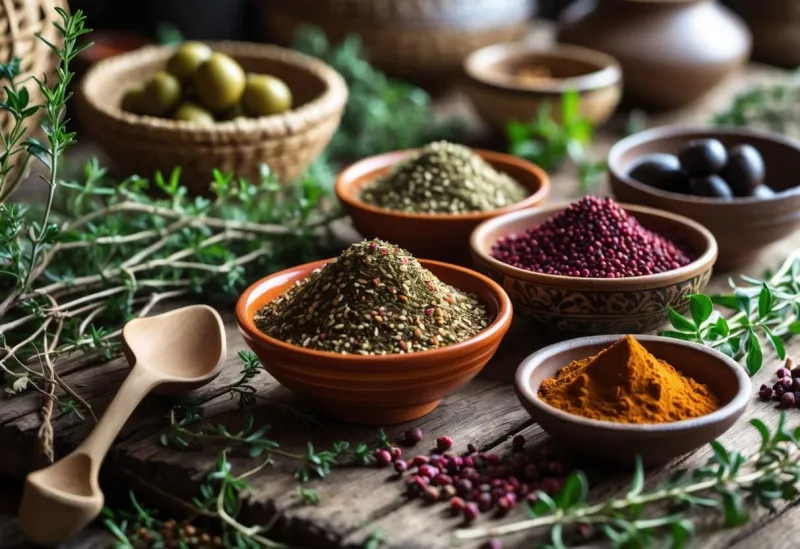
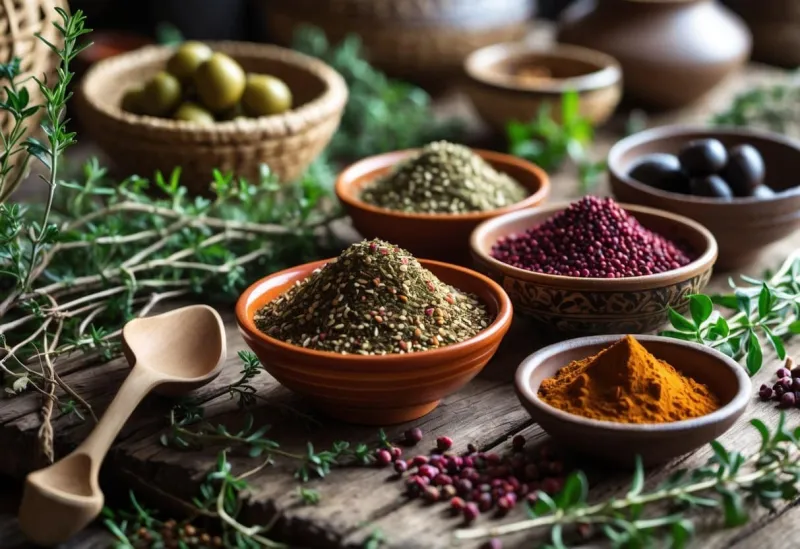
Photo: Lebanese spices sumac za'atar pomegranate molasses on wooden table with Middle Eastern market background, via amazingfoodanddrink.com
There's a small jar of sumac sitting in a lot of American kitchens right now. Maybe yours. It might have come from a Middle Eastern grocery in Dearborn, Michigan, or off a specialty shelf at a Trader Joe's in Austin, or maybe a Lebanese neighbor handed it over the fence and said, "just try it on your eggs." However it got there, that little jar carries a story that stretches back thousands of years — across mountain passes, Mediterranean ports, immigrant ships, and corner delis run by families who brought their whole world with them.
Lebanese cuisine didn't arrive in America fully formed. It traveled. And tracing that journey is one of the most satisfying ways to understand why these flavors feel both unfamiliar and somehow immediately right.
The Levant Was Always a Crossroads
Lebanon sits at a geographic intersection that made it, for most of recorded history, one of the most important trading hubs on earth. The Phoenicians — the ancient seafarers who called this coastline home — were moving goods between Egypt, Greece, Persia, and beyond well before the common era. Spices, resins, dyes, and dried goods flowed through Lebanese ports for centuries before the more famous Silk Road formalized those connections.
What this meant, practically, is that Lebanese cooking absorbed influences from every direction. Persian saffron, Indian black pepper, Syrian sumac berries, North African cumin — all of these ingredients found their way into Levantine kitchens not as exotic imports but as everyday staples. Lebanese cooks didn't just adopt these spices; they made them their own, developing flavor profiles and preparation methods that are distinctly, recognizably Lebanese.
That layered history is exactly why Lebanese food tastes the way it does: complex without being complicated, warm without being heavy, bright and earthy at the same time.
Sumac: The Tangy Berry That Traveled Everywhere
If you've never cooked with sumac, the short version is this: it's a deep burgundy spice ground from dried berries, and it delivers a tart, fruity acidity that behaves nothing like lemon juice but fills a similar role. Lebanese cooks use it on fattoush, folded into onion salads, sprinkled over hummus, and dusted onto grilled meats.
Sumac grows wild across the eastern Mediterranean and parts of the Middle East. For centuries it was the primary souring agent in Levantine cooking — before citrus became widely available, sumac was doing that job. The Romans used it extensively. Medieval Arab cookbooks reference it constantly. And when Lebanese immigrants began arriving in the United States in the late 1800s and early 1900s, sumac was among the ingredients they either brought with them, sourced from small import shops, or simply missed desperately until they could find it again.
Today, sumac is having a genuine mainstream moment in American cooking. Food writers have championed it, restaurant chefs have put it on everything from roasted carrots to cocktail rims, and home cooks are discovering that a pinch of it transforms a simple dish in a way that's hard to explain until you taste it. That rise isn't random — it's the latest chapter in a very long story.
Za'atar: A Blend That Carries an Entire Landscape
Ask a Lebanese person about za'atar and watch their expression shift. This isn't just a spice blend — it's a memory delivery system. Za'atar (the blend, not just the herb) typically combines dried thyme, sumac, sesame seeds, and salt, though every family and every region has its own proportions and additions. The herb itself, a wild thyme variety that grows in the rocky hillsides of Lebanon and the broader Levant, has a slightly more pungent, almost oregano-like quality compared to the thyme you'd find at an American supermarket.
Za'atar traveled with Lebanese immigrants as both an ingredient and a cultural anchor. In early Lebanese-American communities, you'd find it mixed with olive oil and spread on flatbread — man'oushe — at breakfast. It showed up in home kitchens across Michigan, New York, and California long before it ever appeared on a Brooklyn brunch menu. The American food world "discovering" za'atar in the 2010s was really just catching up to what Lebanese families had been doing for generations.
For American cooks getting started with za'atar, the simplest entry point is also the most honest one: good olive oil, good za'atar, warm bread. That combination hasn't needed improving in about three thousand years.
Pomegranate Molasses: The Ingredient That Makes Everything More Interesting
Pomegranate molasses is exactly what it sounds like — pomegranate juice reduced down into a thick, intensely flavored syrup that hits sour, sweet, and slightly bitter all at once. It's used in Lebanese cooking the way a great vinegar or citrus might be used in other traditions: as a finishing note, a marinade base, a salad dressing component, a glaze.
The pomegranate itself is one of the oldest cultivated fruits in the world, with origins in the region spanning modern-day Iran through the Levant. Its symbolism in Lebanese and broader Middle Eastern culture runs deep — fertility, abundance, celebration. The molasses form concentrates all of that into a bottle you can now find at most well-stocked American grocery stores, often right next to the tahini.
What makes pomegranate molasses so compelling for American home cooks is how immediately it expands your flavor vocabulary. A drizzle over roasted eggplant, stirred into a pan sauce, mixed into a vinaigrette — it adds a dimension that's genuinely hard to replicate with anything else. Once you have a bottle in your fridge, you'll start finding uses for it everywhere.
Immigration as Culinary Infrastructure
None of these ingredients would be sitting in American pantries without the people who carried them here. Lebanese immigration to the United States happened in waves — a significant first wave in the late 19th and early 20th centuries, followed by larger movements driven by the Lebanese Civil War in the 1970s and 80s, and continued immigration since. Each wave brought cooks, families, and food traditions that gradually embedded themselves into American culinary life.
The Lebanese-American communities that built up in cities like Detroit, New York, Los Angeles, and Cleveland didn't just preserve their food culture — they created the supply chains that made these ingredients available. Small import businesses, family-run grocery stores, and community bakeries became the infrastructure through which Lebanese pantry staples first became accessible to non-Lebanese Americans.
That infrastructure has now scaled dramatically. Specialty grocers, online spice retailers, and mainstream supermarkets have all caught on to the demand for authentic Lebanese and Middle Eastern ingredients. What was once a specialty item requiring a specific trip to a specific neighborhood is increasingly just... available.
Why the History Actually Matters in the Kitchen
Knowing where an ingredient comes from doesn't just make for good dinner party conversation (though it absolutely does that). It actually makes you a better cook. When you understand that sumac was used as a souring agent for centuries before lemons were common, you start to intuit how to use it — not as a garnish, but as a functional flavor component. When you know that za'atar was traditionally mixed fresh and eaten immediately, you treat your store-bought blend differently, maybe toasting it lightly to wake it up.
The Lebanese pantry isn't a collection of exotic add-ons. It's a toolkit shaped by geography, trade, culture, and centuries of practical cooking wisdom. Every jar and bottle in it has a story. And the best part about cooking with these ingredients in an American kitchen today is that you get to add your own chapter to that story — one meal at a time.